
Fiserv
& Clover
Designing scalable financial experiences that connect product, usability and brand consistency for global merchants.
Fiserv is a global leader in financial technology, powering payment systems and banking infrastructure worldwide.
Clover is its flagship POS ecosystem, designed to help merchants manage payments, operations and business growth.
The challenge was to design and evolve product experiences within a complex fintech ecosystem, balancing usability, scalability and brand consistency across different markets and business needs.
Tools
Figma · User Flows · Agile (Scrum/Kanban) · Design Systems
Skills
UX/UI Design · Cross-functional collaboration · Product thinkingInformation Architecture · User Flows · Interaction Design · Visual consistency · Fintech experience


THE CHALLENGE
How do you design a scalable financial experience across global systems and local payment realities?
Operating within Fiserv meant dealing with a highly complex financial ecosystem, where multiple products, partners and market dynamics coexist. Within this context, Clover needed to support different merchant profiles while maintaining a consistent and scalable product experience.
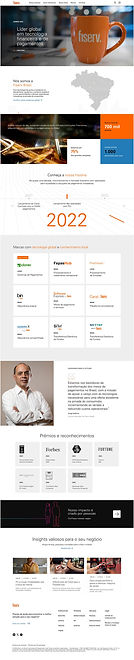
In Brazil, this complexity expanded further through integrations with local payment solutions such as BIN and Azulzinha da Caixa, each with their own operational logic, constraints and user expectations.
The challenge was to translate this fragmented and multi-layered environment into clear, intuitive and reliable experiences, ensuring that merchants could operate financial tools with confidence, efficiency and minimal friction, while still aligning with global standards and business requirements.

Key Work
My work focused on structuring and improving product experiences within a complex fintech environment, especially considering local integrations such as BIN and Azulzinha da Caixa. This included refining user flows, improving information architecture and designing interfaces that could simplify operational complexity without losing robustness.
I also contributed to the evolution of design patterns and consistency across the ecosystem, ensuring that different touchpoints felt connected and aligned. Throughout the process, I supported product decisions by bringing clarity to trade-offs between usability, scalability and technical feasibility.
🔗 Figma Clover preview
🔗 Figma BIN from Fiserv preview
🔗 Figma Azulzinha da Caixa preview
Strategic Approach
Working across Fiserv initiatives and the Clover ecosystem, my approach focused on connecting product structure, usability and consistency at scale.
This involved deeply understanding how global platforms adapt to local realities, especially in scenarios involving BIN and Azulzinha da Caixa, where operational flows and user behaviors differ from standard implementations. From this perspective, I contributed to structuring user journeys, refining information architecture and designing interfaces that could accommodate complexity without exposing it to the user.
The work was developed in close collaboration with product managers, engineers and stakeholders, balancing business goals, technical feasibility and user needs. More than designing screens, the focus was on making informed decisions that would improve clarity, reduce cognitive load and strengthen the overall experience across different touchpoints of the ecosystem.


Why this project matters
I acted as a Strategic Product Designer within the Fiserv ecosystem, contributing to the evolution of Clover and its adaptations to the Brazilian market. My role sat at the intersection of UX, UI and product thinking, where design decisions needed to balance user experience, business objectives and technical constraints.
I worked closely with cross-functional teams, including product managers, engineers and stakeholders, helping translate complex financial requirements into clear, usable and scalable solutions.

Outcome
The project resulted in more intuitive and cohesive product experiences, reducing friction in key merchant interactions and improving overall usability. By simplifying flows and strengthening interface consistency, the solutions helped make complex financial operations easier to understand and execute. The work also contributed to a more scalable product structure, enabling the platform to better support different market needs while maintaining alignment with global standards.